Tuesday, November 4, 2008

More Goodies for Election Watching

As supplements to my election watching guide, I've posted two items below:

1.) A chart with all of the poll aggregations for each state, the odds of victory for each candidate, and the time(s) that polls close.

2.) A scorecard to keep track of the electoral math when results start rolling in.

I have pdf and excel versions I can send you if you e-mail me. Click on each image to see it in a readable size.

Your Election Watching Guide

I know, I swore I'd only write one piece on the election . . . but I couldn't help myself.

If you're anything like me then tonight you'll find yourself in front of a TV with friends or family watching the election returns come in. Since you're reading this blog I'll assume that you're smart and well-informed, but many of those friends and family that are watching with you might not be. Rather than succumbing to information overload, here are a few things to look out for, in the form of answers to the following key questions:

1.) What are the odds that Obama/McCain will win?
2.) What are the key states to watch?
3.) When will we know it's over?
4.) What's going on with the Senate; will the Dems win 60 seats?
5.) How reliable are the polls?
6.) Anything else I should keep in mind?
7.) Couldn't you have said that all in one paragraph? (a.k.a the summary)


What are the odds that Obama/McCain will win?

According to FiveThirtyEight.com, there's a 98.9% chance that Obama will win the election. Why so high? Read on . . .

Depending on which national tracking poll you follow, you might think that the race is close. But candidates don't win based on the popular vote; they win based on victories within states. Here are how the polls indicate the states are leaning right now. Following each state is the number of electoral votes that state has (in parentheses) and four indicators of how far ahead the favored candidate is in that state:

1. The average of the recent polls, computed by RealClearPolitics
2. The average of the polls, using a regression line, computed by Pollster.com
3. The projected vote, using poll averages, historical trends, and demographic data, as computed by FiveThirtyEight.com
4. The odds of victory, as computed by 538

McCain Will Win in:
South Carolina (8)
Texas (34)
Alabama (9)
Mississippi (6)
Tennessee (11)
Kentucky (8)
Oklahoma (7)
Arkansas (6)
West Virginia (5)
Kansas (6)
Nebraska (5)
Utah (5)
Idaho (4)
Wyoming (3)
Alaska (3)
Total: 120

McCain is definitively ahead in:
Louisiana (9): N/A|10.6|9.9|99%
South Dakota (3): 8.3|8.0|8.8|99%
Arizona (10): 3.5|4.9|4.9|94%
Georgia (15): 4.0|2.9|3.7|90%
Total: 37

McCain is slightly ahead in:
Montana (3): 3.8|2.2|2.7|81%
North Dakota (3): N/A|0.7|2.7|76%
Indiana (11): 1.4|1.2|1.5|70%
Total: 17

The following states are true toss-ups:
Missouri (11): M0.7|O1.1|M0.2|M53%
North Carolina (15): M0.4|O0.4|M0.2|M53%%
Total: 26

Obama is slightly ahead in:
Florida (27): O1.8|O1.7|O1.7|O73%
Ohio (20): 2.5|3.1|3.4|88%
Total: 47

Obama is definitively ahead in:
Nevada (5): 6.8|7.1|4.9|95%
Virginia (13): 4.4|5.6|5.6|97%
Colorado (9): 5.5|7.6|6.6|98%
Pennsylvania (21): 7.3|7.2|8.1|100%
Total: 48

Obama will win in:
New Hampshire (4)
Minnesota (10)
New Mexico (5)
Massachusetts (12)
Connecticut (7)
Maine (4)
Rhode Island (4)
Vermont (3)
New York (31)
New Jersey (15)
Maryland (10)
D.C. (3)
Delaware (3)
Michigan (17)
Illinois (21)
Wisconsin (10)
Iowa (7)
California (55)
Washington (11)
Oregon (7)
Hawaii (4)
Total: 243

McCain will win 120 electoral votes. He's definitively ahead in states worth another 37 and slightly ahead in states worth another 17. That brings him up to 174. If he wins all the states in which the race is a toss-up (26) or where Obama's slightly ahead (47) that would give him 247 electoral votes. 270 are needed to win. That means he needs to win 23 electoral votes from among NV, VA, CO, and PA -- all of which are long-shots for him.


What are the key states to watch?

McCain has a very small margin of error, so if he loses any close state it's a big deal. In other words, there an awful lot of outcomes that would prevent him from winning 270. If you scroll up and read through the chart again, you'll see that Pennsylvania would put him close if he also wins all the closest states. Since it would take a miracle to win either PA, however, the more likely way that he could go over the top is to win Virginia, Colorado, and Nevada. That won't be easy, but it's certainly something to keep an eye on. In other words, if McCain loses Virginia it's pretty much over -- and if he loses both PA and VA then he should call Obama and concede.

Virginia is the state with the earliest poll closing time that is likely to serve as a firewall for Obama. But it's not the only state to watch. Barring a miracle in PA, McCain has to win virtually every single state in which Obama's not already ensured victory. All of his safe states + the close states only gives him 247 electoral votes. Adding VA, CO, and NV would give him 274. That means he only has four electoral votes to spare. In other words, if he loses any of the following states (in order of likelihood of losing): CO, VA, NV, OH, FL, NC, MO, IN, GA, AZ, LA, SC, WV, TX, AR, MS, TN, KY, KS, NE, AL, OK, or UT or two of: ND, MT, SD, AK, ID, and WY then he's virtually assured to lose (again, barring a miracle in PA).


When will we know it's over?

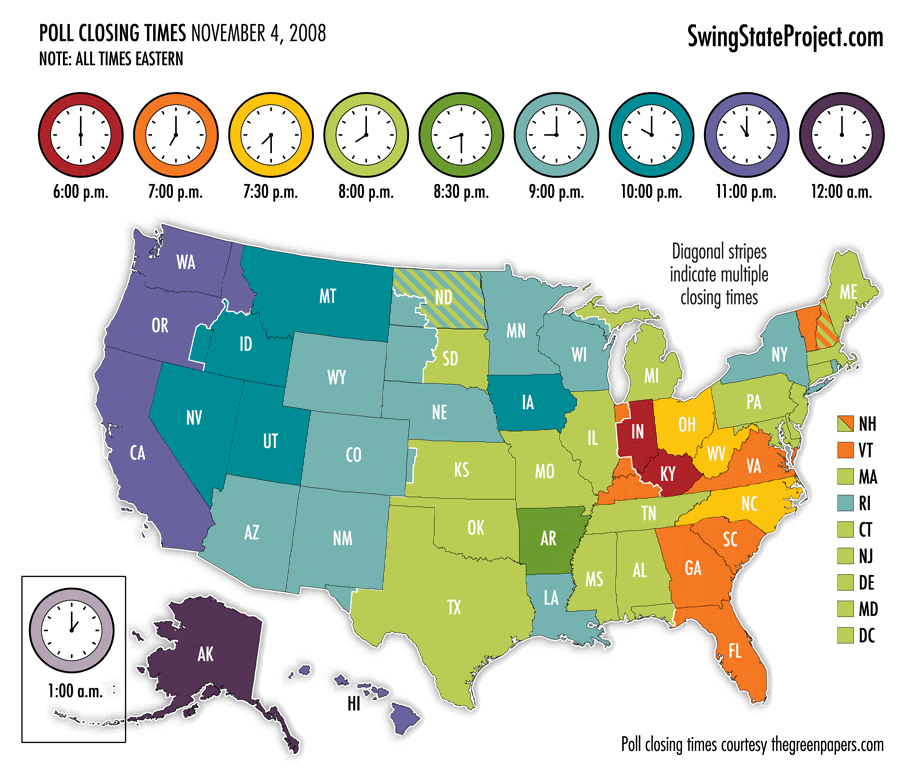
Depends on what your definition of "know" is. January 20th is the safest bet. When the networks put a check mark next to one of the candidate's names is the second safest bet. If and when McCain loses Virginia, however, you'll pretty much know. When might that be? Here's a list of the time that polls close in every state (a second time listed in parentheses means that part of the state closes earlier -- results will start trickling in then, but after the Florida debacle in 2000 no network in their right mind will call the state yet). If you're a graphical person, here's a cool map of all the closing times. All times are Eastern.

7pm
KY & IN (6pm)
SC, GA, VA, VT

7:30pm
WV, NC, OH

8pm
FL & NH (7pm)
MS, TN, AL, OK, MO, PA, ME, NJ, CT, MA, DE, IL, MD, DC

8:30pm
AR

9:00pm
TX, KS, SD, LA, ND, MI (8pm)
NE, WY, AZ, CO, NM, MN, WI, RI, NY

10pm
UT, MT, NV, IA

11pm
ID & OR (10pm)
WA, CA

midnight
Alaska

1am
Hawaii


What's going on with the Senate; will the Dems win 60 seats?

The senate will be much more heavily Democratic than it has been in a long time. A lot of people are speculating about the possibility that Democrats will control 60 seats in the Senate (60 is an important number b/c it takes 60 votes to override a filibuster). 60 seats is a reach, but 59 is not. Since the Presidential race will likely be over early (regardless of how long it takes the networks to actually put that check next to somebody's name), the true political junkies will be watching the Senate races. Here's what to watch for:

The Democrats currently control 39 seats (including the two Independents) and the Republicans 26. 35 seats are up for grabs; of those, 17 are virtually assured to go Democratic and 12 Republican. That gives the Dems a minimum of 56 seats (a week ago that number was 55, but then Ted Stevens (R-AK) was convicted on felony charges and the race went from a toss-up to a sure win for the Dems). That leaves 3 races that are eminently winnable for the Dems:

-Jeff Merkley (D) is all but a shoe-in over Gordon Smith (R) in Oregon -- giving them 57 seats.
-Kay Hagan has a bit closer race in North Carolina, but will likely beat Elizabeth Dole -- which brings them to 58.
-Al Franken (D) is currently a toss-up against Norm Coleman (R) in Minnesota (polls have ranged from Franken (D) +5 to Coleman +6 in the last week) -- meaning that the Democrats have a legitimate shot at 59.

Winning a 60th seat, however, will be tough. There are three races that will likely be won by Republicans but that are not quite automatic victories. If the Democrats can win one of those three, it could mean that they will control a filibuster-proof majority in the Senate. Those three are:

-Minority leader Mitch McConnell (R) will likely beat Bruce Lunsford (D) in Kentucky
-Saxby Chambliss (R) will probably beat Jim Martin (D) in Georgia, but some polls have this race very close
-Roger Wicker (R) is the favorite to defeat Ronnie Musgrove (D) in the special election in Mississippi

For a more thorough breakdown, see 538's final senate projections.


How reliable are the polls?

Well, I guess we'll find out pretty soon.

Overall, we should expect the polls to provide a rough picture of what will happen. Some individual polls will certainly be far off, but it would be a surprise if the general trends are wildly out of line. That said, it's not impossible. Polls could be wrong for any number of reasons, but three key ones this year are:

1.) Cellphones. A large number of Americans use cellphones instead of landlines most or all of the time. People under 30 -- a demographic that heavily favors Obama -- are especially likely to do so. By federal law, however, pollsters cannot use automatic dialing machines to call cellphones. This means that in order to sample cellphone users a pollster has to pay a human to dial those numbers by hand -- a task that is many times more expensive. As a result, many of the polls do not sample cellphone users. Theoretically, correctly weighting responses can still yield accurate estimates -- but that may or may not be happening. A recent glance at the national polls found that those who sampled cellphones had Obama up 9.4 points and those that didn't had him up 5.1.

2.) Who will vote? In deciding whether or not their sample is representative of the population pollsters rely on their estimates of who will vote -- in other words, their "turnout models." Normally, pollsters can predict with some precision what percentage of the voters will be of a certain age, race, or party affiliation. They factor in those demographics, along with questions asked of individuals (for example, about whether they've voted in the past, how likely they are to vote this year, etc.) in order to decide who is likely to vote and what the entire population of voters will look like. This year, however, may prove harder to predict. Huge numbers of people registered to vote for the first time during the primaries and over the summer and nobody is quite sure how many of those people will vote. Furthermore, many are speculating that larger than average numbers of young voters and African-American voters (both groups that support Obama by large margins) will turn out on or before election day.

3.) The "Bradley Effect." Named for California Gubernatorial candidate Tom Bradley, the Bradley Effect is the notion that White voters will tell pollsters they're voting for the Black candidate so that they don't appear racist but, ultimately, will pull the lever for the White candidate when nobody is looking. Empirical evidence suggests that this happened with some regularity in the 80's and early 90's but is no longer a factor. Interestingly, it may not have actually happened to Tom Bradley (both his aide and his opponent's aide argue that it's a myth).

In short, polls could be off-target for a large number of reasons but there are a couple of large issues that could mean that polls are regularly underestimating Obama's support.


Anything else I should keep in mind?

Other than not taunting your friends (too much) that were rooting for the other guy if your candidate wins or leaving the country if your candidate wins here are some things to keep in mind:

1.) Early voting. As you can see in more detail on this map, a lot of people are voting early -- and in key states. Poll results have indicated that early voters are leaning more toward Obama -- often by huge amounts -- than are people who have yet to vote. In some states the majority of the electorate has already voted, and Obama is up by quite a bit. The table below shows the results reported in a few polls within the last week (click on the table to see it in readable quality).

CNN's website has a map where you can see the number of votes cast early by state; sometimes broken down by party ID.

Assuming the polls are accurate, these results could mean any number of things. It could indicate that Obama's supporters voted early and McCain's supporters are voting later (which wouldn't affect the results). Or it could mean that Obama's supporters are more enthusiastic and better organized. Or it could mean that the current voter turnout models the pollsters are using are significantly underestimating Obama's support. It's tough to imagine, however, that there's any way that these numbers could help McCain. Indeed, starting election night down about 20 points with about 2/3 of the votes cast, as he is in CO, NV, and NM, is not a position in which I'd want to find myself. Georgia, by all rights, should vote for McCain, but Obama is ahead with over half the votes counted -- if that result carries through it's a sign that pollsters significantly underestimated the turnout of Obama voters, that these early voting results matter, and that Obama will win in a rout.


Couldn't you have said that all in one paragraph?
(a.k.a the summary)

Yes, I could've. For those of us who like brevity, here's the condensed version:

The latest polls give Obama heavy advantage, but don't preclude any possibility of a McCain victory. McCain essentially has to win every single state in which the race is close except for Nevada in order to win -- or pull out a miracle in Pennsylvania. If he loses Virginia it's highly unlikely that he'll win. If he loses both VA and PA, it's over. The senate race essentially starts out with the Dems controlling 57 seats. A Hagan victory in NC and Franken victory in MN would give them 59. If they steal a seat in MS, KY, or GA they'll have a filibuster-proof majority. This all assumes, of course, that the polls are reasonably accurate. Whether or not pollsters accurately estimated who will vote will likely determine their accuracy. The fact that so many people (most of whom were Obama supporters) voted early is something to keep your eye on -- it might mean nothing, but it could signal an impending Obama rout. If Obama wins Georgia, it's a sign of just that.


In case you were wondering, here are my predictions:

1.) Obama will win 364 electoral votes and win the popular vote 52-45
2.) We'll know he's won when Virginia is called for Obama -- at, I'll say, 8:30pm Eastern
3.) The Dems will control 59 seats in the Senate when all is said and done

Update: My follow-up post contains two things you might find helpful while watching the election: a spreadsheet with all the information you want to know about each state (how many electoral votes, who's up in the polls by how much, and what time(s) the polls close) in addition to a scorecard that will help you keep track of who's winning.

Enjoy your election watching.

Sunday, October 26, 2008

The Biggest Problem with Schools: Tradition

I've finally found something with which every single education reformer can agree: the biggest problem facing our schools today is tradition. We do so many things for no other reason than because that's the way they were done in the past.

Why should everybody agree with this? Below is a list of various solutions that people push and how tradition keeps them from happening:

School Choice
Every neighborhood has, traditionally, had its own school. The neighborhood builds, maintains, and governs these schools for the use of locals -- not for the use of people from other neighborhoods -- and is used to spending their money on their schools; not on sending children to other people's schools.

Smaller Classes
Classes have, traditionally, been somewhere between 20-40 kids. Classrooms are built for classes this size.

Longer School Year
Traditionally, schools have taken the summer off to allow people to move to different places (not to harvest crops -- that's a myth) and then have everybody start fresh, at the same level, when September rolls around. Summer camps, swim team, family vacation, etc. are all scheduled for the summer when school's out.

A More Progressive Pedagogy
Traditionally, the teacher has been the "sage on the stage" and run a mini dictatorship in the their classroom. In other words: teachers teach the way they were taught, not the way they were taught to teach.

Smaller Schools
Traditionally, schools have housed all of the students from a certain region. Those regions coalesce around their schools to attend school plays, high school football games, etc. In some places, very little property is available where another school could open.

Banish Unions
Traditionally, teachers in many places have belonged to unions. The current contracts have been negotiated by unions. Unions have influenced the salary schedule, work rules, seniority, etc.

Recruit/Retain Better Teachers
Traditionally, most teachers have been females who had few better career options. Now that the most successful female students can enter just about any field, the teaching field continues to attract and retain people who don't feel they or rather would not pursue employment in other fields.

I could go on and on, but I think those are most of the major reform ideas floating around right now. In each case, the biggest hindrance to the idea's implementation is tradition. Still unconvinced? Here are a few other examples of ways in which tradition influences decisions:

-College professors assign hundreds of pages of reading each week, not because it's the best pedagogy but because that's what they did when they were college students.
-Grad schools assign comprehensive exams, not necessarily b/c it helps the students in any particular way but b/c the people in charge all had to take comprehensive exams when they were in grad school.
-Report cards are sent home each semester with letter or number grades (which are virtually identical across schools), not because this necessarily serves a purpose, but b/c that's the way it's always been done.
-Teachers at all levels often use textbooks as the main way to educate their class -- certainly not because textbooks are always fantastic but, rather, b/c that's the way people have always done it.

Ok, that's enough. None of those things are necessarily bad in and of themselves, but ask yourself this: if you were starting a school from scratch -- blank slate, you can do anything you want -- how many of those would you want done in the same way they are now? And you're not allowed to use the phrase "when I was in school" in your justification.

The point is this: people are comfortable doing things the way they've always been done. But we can't eliminate either tradition or human nature, so what's the solution? I don't know exactly, but here are some things to think about:

First of all, I guarantee you that none of those ideas, alone, are a silver bullet -- and everybody needs to come to grips with that. Let me repeat: there is no silver bullet. No one idea is going to magically transform our schools. As such, it's not worth losing your temper when your pet reform meets some opposition.

With that said, I think we also need to realize that a great deal of the opposition to the ideas we know will magically transform the schools comes from human nature, not ill will. Not everybody who doesn't implement your reform is a bad person. I have a lot of pet peeves around education reform, but I'll tell you my top one: when reformers blame the people in place for not implementing their reform correctly.

Time after time we see studies of education reform done and almost all of them find either no changes to results or very small ones. At this finding the people who were sure that the reform would work work become indignant -- "the curriculum is solid, but the teachers just kept teaching the way they've always taught" or some such complaint. In other words, "if they just would've done things exactly as I wanted them done . . ."

Well, let me give you hint: nobody will ever do things exactly the way that you want them done. And they certainly won't do them that way if you simply go in and demand that they be done that way. Too many people forget to factor in whether the people they're trying to change a.) want to do things that way and b.) know how to do things that way. In this case, if the teachers didn't want to and/or know how to implement the curriculum correctly, it is a failure of your reform. Part of the job of a reformer or policymaker is to take into account how people will respond to the new policy/reform. Things don't always work out as planned, and when that happens you can chalk it up to human nature on the part of the reformees and lack of understanding of human nature on the part of the reformers.

So, in short, the first step to overcoming the limitations that tradition is placing on our school is this: understand that tradition that's holding us back. Then try and find a way to change tradition. And remember, changing a tradition is hard.

Wednesday, October 22, 2008

Will an Obama Victory Shrink the Achievement Gap?

Even if it did, I get the feeling that this is one of those questions that will never be definitively answered -- no matter how sophisticated the statistics. 4 or 8 years of an Obama White House would simply coincide with too many other events to prove that it was Obama's election that caused the change.

I'm unconvinced that the President (or anybody in the federal government) has the policy tools necessary to fundamentally alter what happens "on the ground" in schools around the country -- which is the only way, in my opinion, that we could expect dramatically different results. But I can't help but wonder if an Obama victory would have some sort of intangible effect on the outcomes of students. Beyond whatever policies he, Linda Darling-Hammond, and the rest of the team would establish, it's not implausible to envision an Obama presidency positively impacting the achievement of African-Americans in any of the following ways:

1.) African-American students gain a new role model. And trying to be like Obama results in higher test scores than does trying to be like Kobe, 50 cent, etc.

2.) The presence of an African-American in the White House reduces the amount of racism in America. The families of African-American students benefit -- through both lifted spirits and fattened wallets -- in ways that help their children do better in school.

3.) Members of all races and ethnicities reduce the amount that they stereotype and students and teachers expect more similar achievement from all students.

I could list more, but I think they start to overlap after a certain point. Whether you believe that these plausible would rely both on whether you think an Obama presidency would have any effect on how people perceive race and on what you think causes the achievement gap.

If you believe the gap exists because African-American students aim low, then idolizing the Editor of the Harvard Law Review could raise the achievement of many students. If you believe the gap exists because African-American families suffer from racial discrimination, then a more tolerant society could lead to a lower achievement gap. If you you believe the gap exists because the peers and teachers of African-American students expect less of them, then the sight of an African-American in the White House could plausibly raise these expectations and, therefore, raise achievement of these students.

Of course, this is all pure speculation. While it's a pretty sure bet that Obama will win the election, I really have no idea if or how the presence of an African-American in the White House will affect race relations in this country. I suppose one could construct a plausible scenario in which an Obama presidency leads to a resurgance of the Ku Klux Klan or some such nasty consequences. And I suspect that, regardless of what happens, we'll never be able to confirm those effects in a statistically rigorous way. But I still think it's something worth thinking about.

Monday, October 20, 2008

Why McCain is Farther Behind Than You Might Think

I'm going to take a quick break from education to write one -- and only one -- post about the presidential election.

The consensus on the election seems to be that Obama is in the lead, but McCain's not out of striking distance (as he says: "we have them right where we want them"). The national polls are a quick snapshot, but they don't reflect the way we elect our next President. The next President will have to win at least 270 electoral votes; not a majority of Americans (though let's hope, whoever wins, that they win both). I hear a lot of talk about the polls, but very few people seem to really break it down. So, here is a breakdown of the states that will decide who wins:

After each state I have placed 5 numbers in parentheses (yes, it's a lot of information -- but it shows just how iffy looking at polls or predicting the race is). Here's an explanation of each number:

1.) A simple average of McCain's average lead/deficit in all recent polls, calculated by RealClearPolitics.com
2.) McCain's average lead/deficit, as calculated by a regression trend, in the polls as calculated by Pollster.com
3.) A snapshot of McCain's current lead/deficit, as calculated by averaging polls and factoring in trends, demographic information, and what's happening in neighboring states as calculated by FiveThirtyEight.com
4.) A prediction of McCain's margin of victory/defeat on election day, given all the information above in addition to historical trends, calculated by FiveThirtyEight.com
5.) The odds of a McCain victory as calculated, again, by FiveThirtyEight.com

In short, the 5 numbers are: 3 estimates of how far ahead/behind McCain is right now, an estimate of what that gap will be on election night, and the odds that he'll win that state. I've rounded all decimals to nearest whole number to make it (slightly) easier to read. All margins are presented from the McCain camp's point of view. In other words, -5 means that he's 5 percentage points behind according to that calculation.

Ok, so McCain needs to win 270 electoral votes in order to win the election. Depending on which website/calculation you believe, there are about 150-160 electoral votes that are solidly polling in McCain's favor or strongly leaning that way. Which leaves about 110-120 electoral votes that he has to win from states that are either toss-ups or in which he's currently behind. For simplicity, I'll take the calculation of 155 leaning/solid McCain electoral votes that RealClearPolitics has and start from there. Assuming he wins the solid states plus Georgia and Montana, he would have 155 electoral votes. Then he needs to start winning some of the closer states. Below are all of the states currently declared "toss-ups."

McCain is slightly ahead in:
West Virginia, 5 electoral votes (+2|+5|+3|+6|91%)
North Dakota, 3e.v. (N/A|+4|+3|+4|84%)
Indiana, 11 e.v. (+4|+3|+2|+2|65%)

Obama is slightly ahead in:
North Carolina, 15 e.v. (-2|-3|-1|-1|38%)
Missouri, 11 e.v. (-3|-1|-2|-1|35%)
Ohio, 20 e.v. (-3|-3|-3|-2|28%)
Florida, 27 e.v. (-2|-4|-3|-3|25%)
Nevada, 5 e.v. (-4|-3|-4|-3|25%)

All those races are currently deemed too close to call by most pundits. If McCain makes a big surge he could, conceivably, win all of them. Let's just say for now that he wins all of the states in which he's currently clearly ahead in addition to every single toss-up state -- which would be quite an accomplishment. That would give McCain 252 electoral votes. Which means that even if McCain pulls that off he would still need to find 18 more electoral votes from somewhere. Here are the states that are currently "leaning" toward Obama:

Colorado, 9 e.v. (-6|-7|-6|-6|10%)
Virginia, 13 e.v. (-8|-9|-6|-6|8%)
New Hampshire, 4 e.v. (-9|-6|-8|-6|8%)
New Mexico, 5 e.v. (-8|-8|-9|-7|7%)

In other words, in order for McCain to win he has to do the following:
1.) Win all of the states that are currently leaning in his direction
2.) Win all of the states that are currently too close to call
3.) Win 18 electoral votes from states in which he's currently far behind (which almost certainly includes VA)

McCain may only be 6 points down in the national polls, but it's not that simple. A national resurgance is not enough. He basically has to win all of the closest states, and then he also has to win at least two other states where he currently has a 1 in 10 chance or less of winning based on a thorough analysis of historical trends, polling data, and demographics.

Another sign that Obama is further ahead than you might think is that all of the closest states right now are ones that Bush won in the last election -- some by large amounts (for example, he won NC by 12 points). The closest Kerry state is NH, which 538 gives Obama a 92% chance of winning and in which most of the recent polls have had him up double digits. Indeed, VA is the must-win state for McCain -- he has virtually no chance of winning if he loses VA -- and it's one that Bush won by 8 points in the last election.

Lest you think that there are other options beyond VA, NM, NH, and CO, here are the next closest states:

Minnesota, 10 e.v. (-10|-7|-9|-8|4%)
Pennsylvania 21 e.v. (-12|-16|-11|-10|2%)
Michigan 17 e.v. (-12|-20|-11|-10|2%)
Iowa 7 e.v. (-12|-11|-13|-13|1%)
Wisconsin 10 e.v. (-11|-8|-11|-10|1%)

The odds of him winning any of these states are slim to none. Which means that there are only a few ways he can win. It basically boils down to two possibilities:

1.) Win all of the close states + 18 electoral votes from VA, NH, CO, and NM
2.) Pull out a miracle

I'm not sure which one is more likely. Any number of things could happen in the next two weeks, but a McCain victory is probably not one of them.

And that's why McCain is even farther behind than you might think.

Update: One more thing I forgot to include that makes like difficult for McCain: early voting. The latest poll shows a dead heat in NC, but Obama is up 23 points among those who have already voted. 538 pointed out the same trend in a number of other battleground states as well last week. So if McCain didn't face a difficult enough task as it is, it looks like Obama supporters are more enthusiastic and better organized in crucial states, which means that:

1.) The polls may be understating Obama's support by underestimating the turnout of his supporters
2.) McCain will already be far behind in the vote tally when Election Day dawns
3.) It will be even harder for McCain to make up ground than you might think

Why Must School be so Punitive?

I'm going to get back to my last post on my contentions at some point this week, but right now I have a slightly related question: why must school be so punitive?

I'm talking about all levels of school: from kindergarten through grad school.

No matter where you go, there always seems to be some sort of implicit threat made to students. There is always pressure and judgment from above. "Do this . . . or else"

Exceptions, obviously, exist. But in general, expectations of students seem to be framed in an accusatory way. Students are expected to do their homework, pass the test, turn in assignments, etc. And there's always some sort of punishment if they don't: bad grade, no gym, no recess, their parents are notified, they'll be kicked out of school, they'll have to repeat the class/grade, etc.

That's not to say that these repercussions are necessarily inappropriate but, rather, that education seems to frequently to mean living up to the expectations set by another person rather than working with that person.

Compare the way that a sports team functions to the way a class functions. Both (presumably) have an expert teaching and training a group. Coaches get angry at players, just as do teachers. Players are punished, just as are students. But, in the end, the players and their coach have no doubt that they share the same goal. The coach is there to make each player better and help the team win. In the end, what's good for the players is also good for the coach. Ostensibly, teachers are there for essentially the same reasons. But perception is reality, and plenty of reasons exist for students to think that their teacher is, at least in some ways, their enemy.

In other words, it seems quite sensible for a student to think that a teacher is there not to help them reach a common goal but, rather, to make them do something they don't want to do. And I don't mean to pick on teachers, since it's the institutional structure of schools that both establishes and reinforces this.

Now, of course, if a student doesn't want to learn how to read it's sensible that somebody be tasked with getting them to do it. If teachers only did what students wanted to do, I have a hard time believing that every teacher would be teaching long division, algebra, the past-perfect tense, etc. But I'm not sure that necessitates the level of heavy-handedness currently present at all levels of schooling.

Right now students are essentially workers and teachers/administrators are their bosses. And the workers have to do what the bosses say . . . or else. And I'm not convinced that's the most effective way to educate somebody.

Tuesday, October 14, 2008

Why Grades Are Stupid

A few weeks ago I wrote a post entitled "Grades Are Stupid" in response to to Pittsburgh's decision to eliminate all grades below 50%. The main thrust of the post was really how Pittsburgh's decision served as evidence that a single grade doesn't really mean all that much.

The post was rather terse and acerbic, but I stand by my original assertion: grades are stupid. Here's why:

Let's say you know nothing about two individuals except for their GPA. What is it that you know about them? Not much. You don't know that one is smarter than the other, because a person can be smarter but not work as hard. You don't know that one works harder than the other because grades aren't based only on effort. You don't know who learned more because you don't know what their teachers' standards were. In the end, you don't really know much at all.

An individual grade is based, to a large degree, on the whims, perceptions, and standards of a specific teacher. Different teachers weight and reward behavior, test scores, homework completion, class participation, etc. differently. Different teachers would give the same paper or test different grades. Different teachers would perceive the same student in very different ways. In other words, a grade is not a particularly valid measure of much of anything. I'm not saying, however, that they are meaningless or devoid of utility -- I don't want to say that grades serve no purpose or provide no information, just that their precision and meaningfulness fall far short of what people often assume.

I chose "stupid" instead of "meaningless" for a reason. Here's one example: The Economist's blog on American politics ran a piece the other week about finding alternatives to the SAT. Their main criteria for finding a replacement seems to be finding something that's more highly correlated with college grades. But are college grades really the most important outcome? Is a high GPA really the definition of success that we want to set?

That a grade, or even a set of grades, provides so little information about a person isn't due just to the fact that grades are subjective and vary wildly by school and teacher. They provide so little information because of the fact that they are based on so little of meaning. What it really comes down to is a teacher's perception of how well a student lived up to that teacher's expectations of a model student.

So, in case I overstated the argument earlier in the post, grades don't give zero information about a student. When you boil it down, they really tell you how close that student came to fulfilling the teacher's expectations. So, what does that mean?

That depends on the teacher. What were the teacher's expectations? Why did/didn't they feel that the student lived up to their expectations?

But it also means that the main skill a student is being measured on is the ability to fulfill the expectations of another person.

In one sense, this is valuable -- particularly if you're the boss and you're looking for somebody who can follow your directions and do what's expected of them. In another, it's not -- particularly if pleasing a boss isn't the most important outcome of one's work.

What's most troubling, however, isn't that the information that grades provide is so sketchy. What's most troubling is that grades send the wrong message in so many ways. While many positive behaviors (studiousness, cooperation, etc.) are rewarded by good grades, grades also reward many behaviors that are not necessarily healthy. Too often, getting a good grade means doing things in a set manner, rather than devising your own way. Too often, getting a good grade means following directions; regardless of the reasonableness of said instructions.  Too often, getting a good grade means living in fear of what will happen if you don't. Ultimately, a school system based on grades (at least in their current form) teaches kids to work for extrinsic rewards and avoid extrinsic punishments. If a high GPA becomes one's goal, what have they really achieved when they accomplish it? And what do students trained to pursue high grades do after they graduate? Pursue promotions? Pursue a higher salary?

And too often grades are used in punitive or heavy-handed ways. Ideally, I think grades are supposed to serve as an indicator of how much a student has learned. But how often are students threatened with poor grades for things not directly related to learning? How often are grades based on a myriad of criteria other than how much a student has learned?

Think back to your own school experience -- at all levels. Think of how many times a grade was based on something other than what you had learned. Think of how many times grades were used as a means of control or coercion. Think of how many times you had to do something to earn a higher grade that did not directly result in you learning more. Think of how much better off you'd be if you focused on the important things in life instead of what your grade would be.

And that's why grades are stupid.

update: as you can see from the many, many comments below, I seem to have taken an unpopular position here.  What that make wonder is if there's a relationship between the GPA one attained when they were in school and their reaction to this post.  In other words, do people who had a higher GPA object more vehemently to the suggestion that grades don't mean as much as we often assume they do?  I'm willing they bet they do.  And I don't suggest that to be flip and deride those who focus on grades as self-promoting.  I'm willing to bet that those who thought grades were more important when they were in school also think they're more important now.  And that those who thought grades were more important earned a higher GPA, on average.  I'm also willing to bet that those who earned a higher GPA would like to believe that that means something important and that those who earned a lower GPA would like to believe that it doesn't really mean all that much.

How Many New Teachers Should a School Have?

The local paper ran a rather bland article yesterday about the number of new teachers in local schools ("School debate value of novice teachers").

According to the people they interview, it essentially boils down to this: newer/younger teachers are more enthusiastic and sometimes relate to the kids better, while older/more experienced teachers have better classroom management, more expertise, and can serve as mentors. Sounds about right to me.

I think you can make a compelling argument that too many of either one is a bad thing. But where is the line for "too many?" This particular article highlights Rutherford County (in the suburbs of Nashville) as having the highest number of novice teachers (due to rapid growth) in the area. 37% of the teachers in the district have five or fewer years of experience.

That's fairly high, but about half what it was in the school where I taught (which was not atypical for middle schools in the Bronx).

I would think that having around one-third of the staff in their first five years (assuming that there's an even distribution within that experience demographic -- e.g. not all of that third are in their first year of teaching) is probably about as high as you would want in an ideal school.

A school where less than a third of the teachers have five years of experience or more, however, should be raising somebody's eyebrows. Not that it's not possible to have a successful school in such circumstances, but it certainly merits further investigation if you're an administrator.

Monday, October 13, 2008

"Am I making sense?" "No."

I often criticize my program for focusing (almost exclusively) on quantitative methods -- at the expense of qualitative methods.* I'm now in my fifth semester and am taking my first class on qualitative methods. I very much want to learn about them/how to use them but I'm troubled by the language used in some of the literature.

Why am I troubled? Because I'm not convinced it makes any sense. I'm sure it makes sense to somebody, somewhere (whoever you are, you are welcome to explain it to me), but it doesn't make sense to me (and I'm not just some nobody they pulled off the street -- I have quite a bit of background knowledge related to this).

I fail to understand why this literature can't be written in language that's more practical and understandable. Is the author trying to impress somebody? Are they so far removed from reality that they think this makes sense? It seems like they're off in their own little world speaking an entirely different language.

Here's one sentences that has frustrated me:

Methods are needed that are simultaneously epistemologically/ontologically based in the soil that nurtured pragmatism, symbolic interactionism, and grounded theory, and that also address demands for empirical understanding of the heterogeneous worlds emerging from this "fractured, multi-centered discursive system" of new world orderings.


*So we're all clear, quantitative methods are essentially numbers-based techniques used to analyze data, while qualitative methods rely on "softer" knowledge, often derived from interviews or observation.

Monday, October 6, 2008

Book Recommendation: Gang Leader for a Day

The last couple weeks have just flown by, and I somehow never found time for a blog post. I did find time, however, to read an excellent book that I picked up a couple months ago: Gang Leader for a Day by Sudhir Venkatesh. If you have a few spare hours, and a few spare dollars, I'd recommend picking up a copy.

Venkatesh is a Professor of Sociology at Columbia whose exploits were chronicled in Freakonomics, but this book chronicles his story before he ascended the ranks of academia. Back when he was a frustrated grad student (like me) he strolled into the projects one day trying to pilot some survey questions and impress the faculty. He accidentally walked in on a gathering of gang members who immediately became suspicious of him. The gang's leader eventually decides that Venkatesh isn't a bad guy and offers to show him how the gang works. The bulk of the book chronicles the six years he spends observing a crack gang, wandering through the projects, and learning first-hand about the lives of the people there.

The living conditions inside the projects are appalling, but not particularly surprising. What I thought was more surprising was the level of complicitness between the gang, the building leader, the housing authority, and the police. The gang helps out the community in a lot of ways and, in exchange, the community looks the other way. Indeed, there seems to be more enmity for the police and the government than for the gang.

Perhaps the most shocking scene in the book is when a handful of police officers march into a gang party. I assumed that mass arrests were going to take place but, instead, the officers demanded that the gang leaders put all of their cash and jewelry into bags that the officers passed around and then left with the loot.

When people hear "gang" or "projects" they assume the worst. But, in the end, it's clear that there was a functioning community behind these. The people he chronicles are poor and they struggle, but they have relationships and they help each other out -- just like any other sector of society. The gang is not simply "evil" and the projects are not simply "bad." The people and their situation is complex, as life always seems to be.

For once in my life, I don't really have any pointed criticism for the book. That's partially b/c it's more of a narrative than anything else -- it reads like a novel -- and partially b/c I really have no idea what he saw and how accurately he describes it. In the end, Venkatesh is mostly content to describe and leave judgment to the reader. My main lament is that he didn't include more stories and observations -- the book is less than 300 pages and I'd have to imagine that he has thousands of pages of field notes.

In addition to being interesting and informative the book is a quick read. It leaves me wishing that more academics could write in such an engaging fashion. And that more academics could write such illuminating pieces on such important topics.